
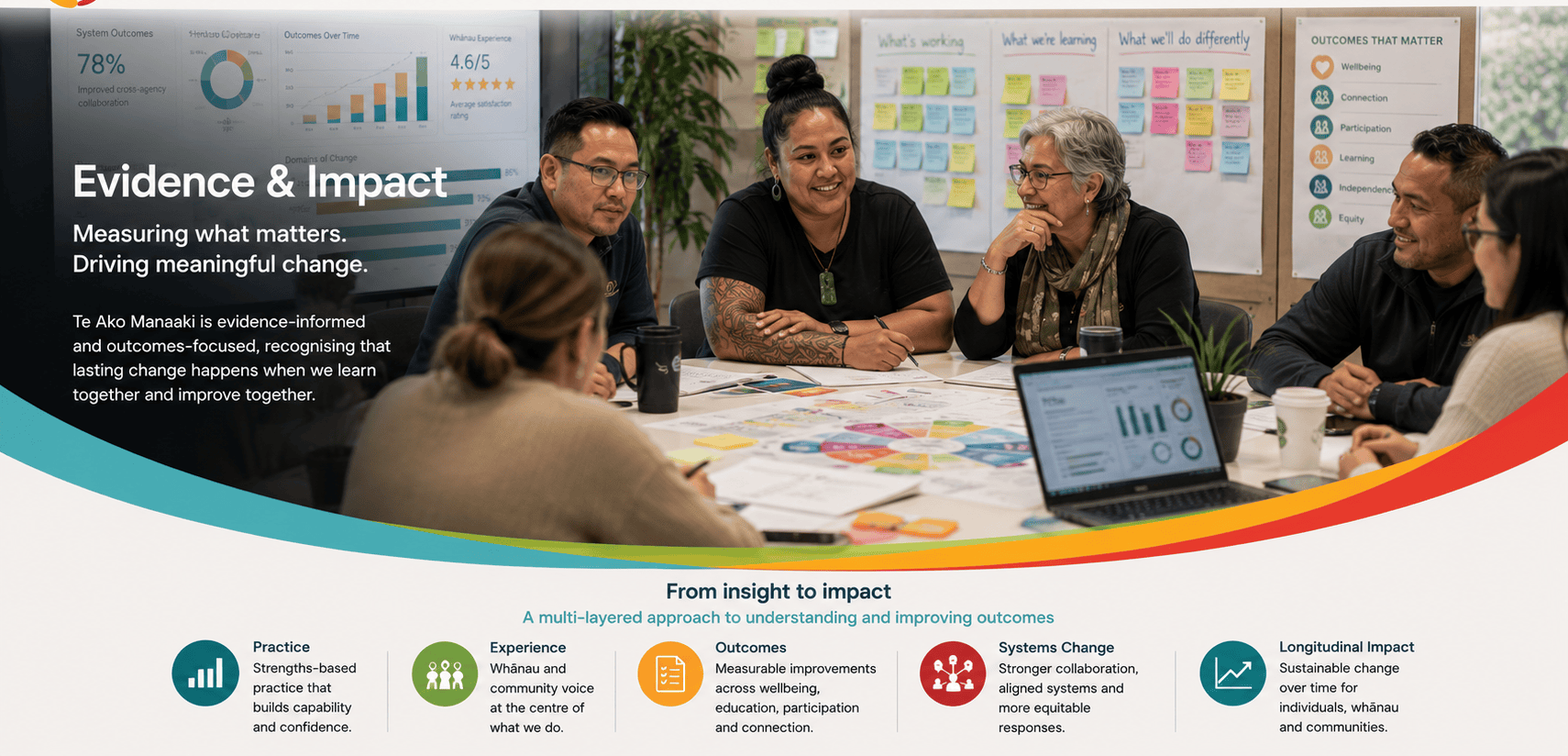
Evidence & Impact
Building confidence through evidence, experience and continuous learning
Te Ako Manaaki brings together outcome data, lived experience, implementation learning, case studies and systems evidence to understand what changes, for whom, and under what conditions.
Why evidence matters
Complex change cannot be understood through one measure alone
Te Ako Manaaki is designed for situations where outcomes are shaped by multiple systems, relationships and conditions. A single output—such as a referral completed, a meeting held or a service accessed—cannot show whether a person’s life has improved or whether the wider system is becoming more effective.
Our approach combines qualitative and quantitative evidence so that immediate changes, lived experience, implementation quality, longer-term outcomes and system effects can be considered together.
The purpose of evaluation is not only to prove impact. It is also to improve practice, guide investment and strengthen collective accountability.
Evidence across the system
Building an evidence base from individual experience to system change
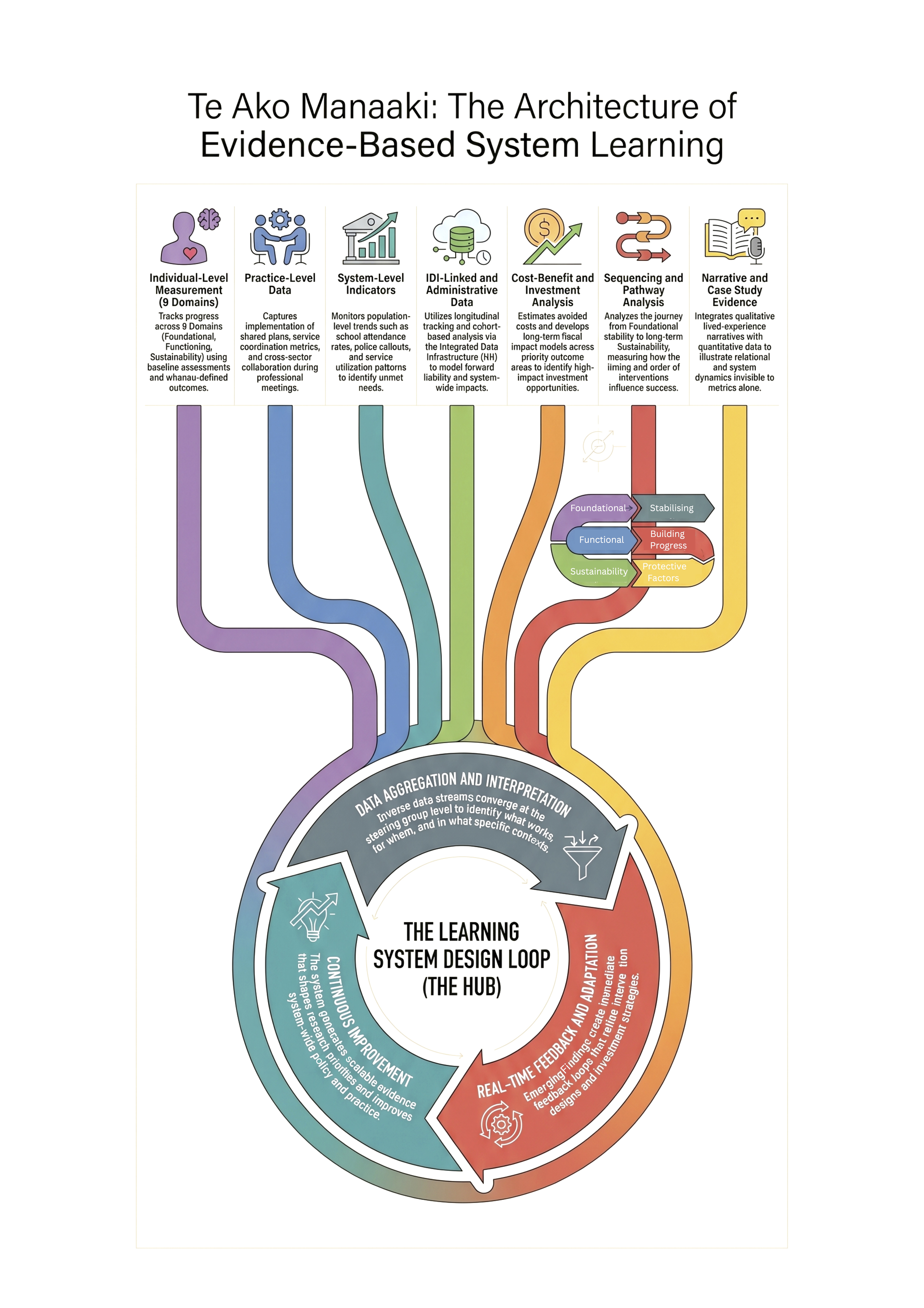
Evidence is gathered at different levels so that we can understand not only whether outcomes are changing, but how practice, organisations and the wider system contribute to that change.
Our evidence framework
Six connected forms of evidence
Together, these provide a more credible picture of impact than any one source can provide on its own.
01
Practice evidence
Reflective practice, supervision, practitioner insight and implementation learning show how the framework operates in real settings.
02
Experience evidence
Participant, whānau and community voice helps us understand trust, access, dignity, participation and whether support feels coherent.
03
Outcome evidence
Changes in engagement, attendance, wellbeing, safety, transition, participation and access to support are tracked over time.
04
Systems evidence
We examine collaboration, referral pathways, service use, role clarity, information flows, network change and recurring barriers.
05
Economic evidence
Cost-benefit analysis, avoided costs and value-for-investment approaches can help funders understand where collective action creates wider value.
06
Longitudinal evidence
Administrative data, linked datasets and longer-term follow-up can show whether early changes are sustained and influence later outcomes.
Evaluation architecture
Evidence is built at multiple levels and across time
Each application can be evaluated proportionately, using the measures and methods most relevant to its purpose, maturity and available data.
Methods
A mixed-method approach
Methods are selected according to the context and the questions the evaluation needs to answer.
Qualitative inquiry
Interviews, focus groups, observation, case studies and thematic analysis.
Outcome measurement
Administrative data, service measures, milestones and changes in agreed outcome domains.
Implementation review
Readiness, fidelity to principles, barriers, enablers, adaptation and capability development.
Economic analysis
CBAx, cost-benefit analysis, service use and wider public-value considerations.
Longitudinal analysis
Linked data, the Integrated Data Infrastructure and follow-up across time where appropriate.
Reflective learning
Structured reflection with practitioners, leaders and partners to improve delivery in real time.
What we are learning
Consistent patterns are emerging across different settings
Relationships are infrastructure
Trusted relationships are not an optional addition to service delivery. They are often the mechanism through which engagement, information and change become possible.
Foundational conditions matter
Learning, participation and progress are difficult to sustain when safety, health, housing, food, identity or belonging remain unresolved.
Coordination must lead to action
Meetings create value only when roles, decisions, responsibilities and timeframes are clear and followed through.
Continuity changes outcomes
Sustained support across transitions reduces the risk that progress is lost when programmes, schools, services or funding arrangements change.
Local insight improves design
Communities and frontline practitioners often understand system gaps and workable solutions before those insights are visible in formal data.
Learning must travel upward
Operational experience should influence governance, commissioning, policy, funding and wider system decisions.
Case studies
Evidence grounded in real experience
These historical stories come from early education and youth-transition applications that contributed to the development of Te Ako Manaaki. Names and identifying details have been changed or reduced.
Historical case study 01
Rebuilding health, trust and engagement
A young person excluded from school and disconnected from learning required coordinated health, whānau, education and relational support.
What changed: health improved, incidents reduced, confidence and learning increased, and a supported transition was established.
Key learning: educational engagement improved when health, material needs, anxiety, trust and learning were addressed together.
Historical case study 02
From exclusion risk to training and employment
A long-term pathway connected Alternative Education, mentoring, Managed Moves, practical support, tertiary study and employment.
What changed: the young person completed training, strengthened leadership and confidence, and moved into stable employment.
Key learning: continuity across education, community, whānau and employment systems enabled progress through setbacks.
Research and development
A growing evidence base
Te Ako Manaaki has developed through implementation, evaluation, practitioner learning and research into how professionals collaborate across organisational boundaries.
Current work includes research into how cross-sector partners define success, negotiate alignment and translate shared intent into coordinated action.
Future research and evaluation will continue to test the framework across different sectors, communities and levels of system complexity.
Recognition
Independent recognition of the work and its potential
Add dates, exact award categories and official links before publishing this section.
Prime Minister’s Education Excellence Awards
Recognition for collaborative work supporting education engagement and improved pathways.
Sustainable Business Awards
Recognition for innovation, partnership and approaches designed to create sustainable social impact.
New Zealander of the Year Community recognition
Recognition of community leadership and collaborative approaches to persistent social challenges.
Evidence resources
Reports, case studies and evaluation material
Delete this section until the documents have been created and uploaded.
Evidence Summary
A concise overview of evidence, learning, outcomes and future evaluation priorities.
Download PDF →Evaluation Architecture
The framework for measuring experience, outcomes, implementation, system change and long-term impact.
Download PDF →Research Reports
Evaluations, research reports and publications supporting the development of the framework.
View reports →Case Study Library
De-identified examples showing application, outcomes, learning and system implications.
Explore case studies →Implementation and evaluation
Interested in implementing or evaluating Te Ako Manaaki?
We work with government, funders, organisations and communities to design proportionate evaluation, strengthen implementation learning and build a credible evidence base over time.
Discuss evidence and evaluation
