
Applications
One framework, shaped for different contexts
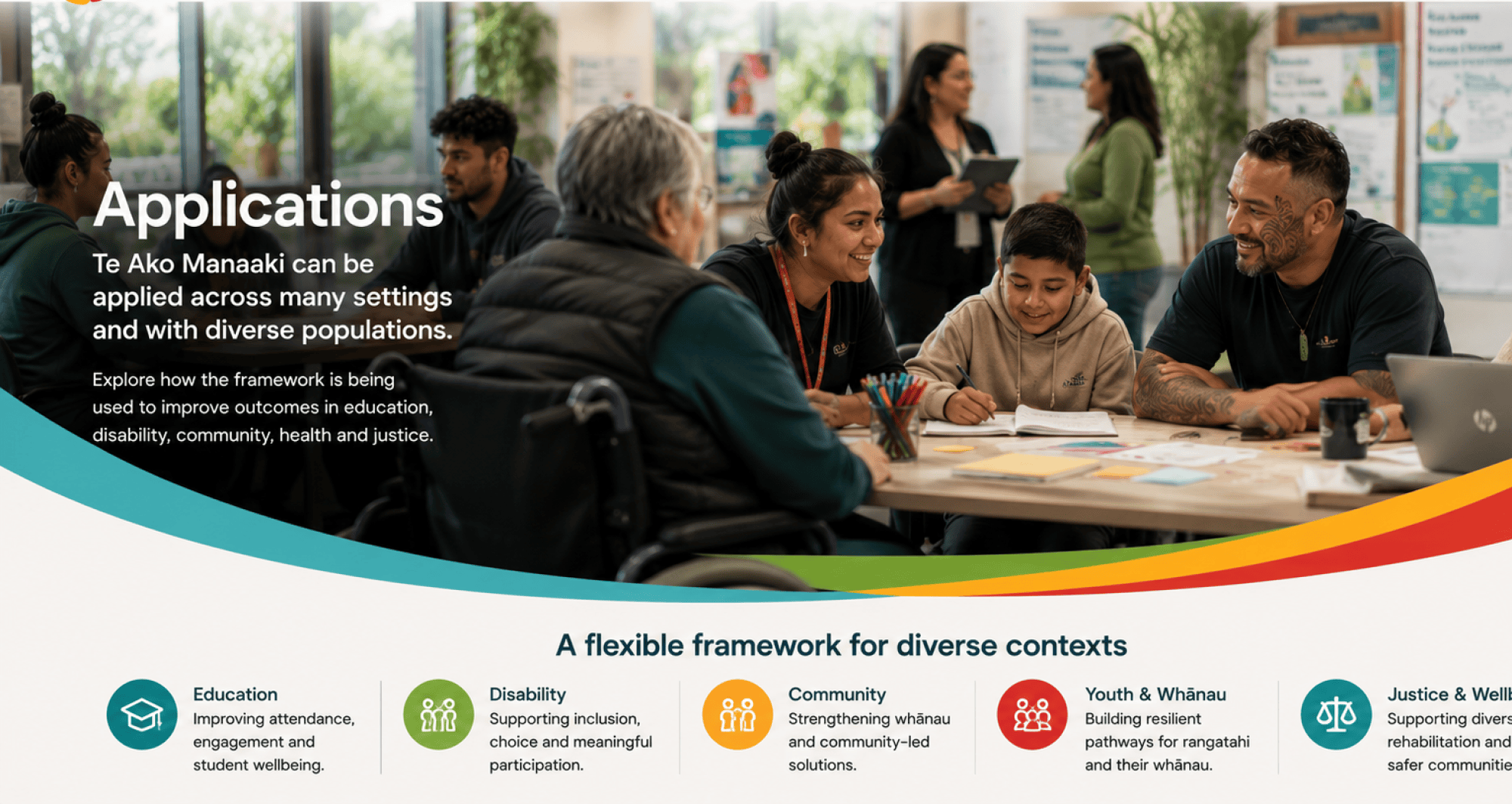
Te Ako Manaaki can be applied wherever people and whānau are navigating complex systems and better outcomes depend on organisations working together.
Adaptable by design
The principles remain consistent. The application is locally shaped.
Te Ako Manaaki is not a fixed service model. It provides a shared structure for strategic alignment, relational practice, collective planning, facilitation, navigation and continuous learning.
Each application begins with the local context: the people and whānau involved, existing relationships, community strengths, system barriers, available resources and the outcomes partners are seeking.
The framework is adapted with communities and organisations, not imposed on them.
Where it began
Education engagement and Managed Moves
Te Ako Manaaki first developed through work to reduce education disengagement and support children and young people whose needs could not be resolved by schools or agencies working separately.
The early Managed Moves application brought education, social services, whānau and community partners together around shared planning, trusted relationships and practical action.
What this demonstrated
- Complex barriers are rarely owned by one service.
- Trusted relationships are essential to sustainable engagement.
- Shared planning must be matched by clear authority and action.
- Local learning should influence wider system decisions.
- Existing resources can achieve more when they are aligned.
Areas of application
Where Te Ako Manaaki can support better collective responses
Some applications are established, while others represent current development or areas where the framework has strong potential. This distinction should remain visible as the evidence base grows.
Established application
Education engagement and attendance
Supporting children and young people whose attendance or participation is affected by multiple, overlapping barriers.
Focus: trusted engagement, barrier assessment, collective plans, coordinated action and sustainable pathways back into learning.
Established foundation
Education transitions and Managed Moves
Creating planned, supported transitions for students at risk of exclusion, disengagement or unsuccessful movement between education settings.
Focus: shared responsibility, preparation, relational continuity, school readiness and coordinated support.
Developing application
Disability and integrated wellbeing
Connecting disability support, health, family, education, housing and community responses around the person’s wider life.
Focus: navigation, continuity, whole-of-life outcomes, safeguarding and coordinated use of formal and informal supports.
Developing application
Youth and whānau wellbeing
Supporting young people whose outcomes are shaped by education, health, care experience, justice, housing, family relationships and community connection.
Focus: trusted adults, shared planning, practical pathways, participation and long-term belonging.
Potential application
Family harm and cross-agency responses
Strengthening alignment where safety, accountability, children’s wellbeing, housing, justice and long-term recovery involve multiple agencies.
Focus: safety, role clarity, information, coordinated action, reflective practice and system learning.
Potential application
Community-led innovation
Enabling communities, iwi, funders and service partners to work together on persistent challenges without defaulting to a pre-designed external solution.
Focus: local strengths, shared purpose, enabling infrastructure, experimentation, evidence and adaptation.
Shaping a local application
The application is built around the outcomes and conditions that matter locally
A local Te Ako Manaaki application usually considers six connected questions.
01
Who is the application for?
Define the people, whānau or community whose outcomes are the shared focus.
02
What outcomes matter?
Clarify what better looks like in people’s lives, not only within individual services.
03
Who needs to contribute?
Identify organisations, leaders, practitioners, communities and trusted relationships.
04
What enables action?
Establish governance, facilitation, navigation, decision-making and practical pathways.
05
How will learning be used?
Connect practice experience and outcomes to service, funding and system improvement.
06
What must remain flexible?
Adapt delivery to local culture, capacity and conditions while protecting the core principles.
Proportionate support
Different levels of complexity require different responses
Applications can be designed around a tiered response so that intensive collaboration is available when needed without making every situation unnecessarily complex.
Universal and early support
Clear pathways and timely help
Accessible information, ordinary service responses, early identification and straightforward coordination.
Targeted collaboration
Coordinated planning
Additional navigation, shared planning and cross-service action where barriers overlap or progress has stalled.
Intensive integrated response
Collective ownership of complexity
Senior oversight, sustained trusted relationships, intensive facilitation and coordinated action across multiple systems.
Examples and case studies
Show how the framework changes practice and outcomes
Add short, de-identified examples here as the case-study library is developed. Each should explain the challenge, the collaborative response, what changed and what was learned.
Future case study
Education and attendance
A complex attendance referral where collaborative work revealed wider care, health, trauma and placement needs.
Read the case study →Future case study
Cross-sector collaboration
An example of agencies moving from parallel activity to shared planning, clear actions and collective accountability.
Read the case study →Future case study
Disability and wellbeing
An example showing how navigation and integrated planning can support a whole-of-life response.
Read the case study →Before publishing: delete these three cards until the case studies are ready, or replace every placeholder URL with a working link.
When it may be useful
Te Ako Manaaki is most valuable where fragmentation is part of the problem
- People repeatedly move between services without sustained progress.
- No single organisation can achieve the desired outcome alone.
- Relationships and trust are essential to engagement.
- Operational barriers require strategic or funding decisions.
- Existing resources are present but poorly connected.
- Partners want to build a locally led response and learn from implementation.
Explore an application
Could Te Ako Manaaki support your community or system?
We can help partners clarify the opportunity, understand readiness, map the local system and co-design an application that reflects local strengths and priorities.
Start a conversation
