
Better outcomes happen when systems work together.
Children, young people and whānau do not experience life in government departments, funding streams or professional disciplines. They experience one life, where education, health, housing, justice, disability, employment and community all interact.
Yet our systems are often designed to respond separately.
Te Ako Manaaki was developed to bridge that gap.
It provides a practical framework for helping organisations work together around the aspirations, strengths and needs of people rather than around organisational boundaries.
Today, Te Ako Manaaki is being applied across education, health, disability, social services and community development, supporting agencies to design services that are collaborative, relationship-based and outcomes focused.
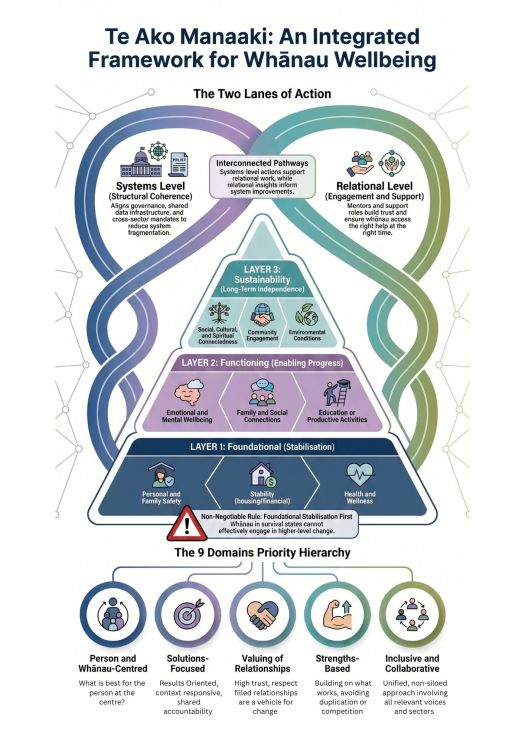
Why Te Ako Manaaki Exists
Complex challenges cannot be solved by a single organisation.
Whether improving school attendance, supporting disabled people, responding to family harm, enabling youth development or strengthening communities, sustainable change requires multiple agencies working in alignment.
Too often collaboration relies on goodwill rather than shared ways of working.
Te Ako Manaaki provides that shared approach.
It helps organisations move beyond referrals and coordination towards genuine collective responsibility for outcomes.
Our Vision
We believe better outcomes are achieved when organisations learn together, work together and share responsibility for the wellbeing of people and communities.
Te Ako Manaaki exists to make that possible.
Our Principles
Te Ako Manaaki is built around a number of core principles.
Relationships first
Trust is the foundation of lasting change.
Strengths before deficits
People are not defined by their challenges.
Whānau at the centre
Solutions are developed with people rather than for them.
Collective responsibility
Every organisation contributes to success.
Learning together
Continuous reflection and improvement are built into practice.
Long-term outcomes
Success is measured by sustainable wellbeing rather than short-term outputs.
How the Framework Works
Rather than prescribing a single programme, Te Ako Manaaki provides an adaptable framework that organisations can apply in different contexts.
It supports:
- Strategic collaboration across agencies
- Shared assessment and planning
- Collective decision-making
- Navigation and facilitation
- Relationship-centred practice
- Continuous learning and evaluation
- System improvement
Because the framework is adaptable, it can be implemented within existing services rather than requiring entirely new structures.
Where It Has Been Applied
Over the past decade Te Ako Manaaki has informed work across multiple sectors including:
- Education
- School attendance
- Managed Moves
- Family harm
- Disability support
- Youth development
- Cross-sector case management
- Community innovation
- Social enterprise
- Government system design
- Strategic planning and evaluation
Its flexibility allows it to be adapted to local communities while maintaining consistent principles.
Evidence and Learning
Te Ako Manaaki has evolved through years of practice, evaluation and collaboration.
Current evaluation work includes:
- Qualitative thematic analysis
- Systems evaluation
- Case study methodology
- Administrative data analysis
- Cost-benefit analysis
- Longitudinal outcomes
- Continuous learning through reflective practice
This commitment to evidence ensures the framework continues to evolve alongside the communities it serves.
Working With Us
We work alongside government agencies, iwi, NGOs, schools, health providers and communities to:
- Design collaborative systems
- Improve cross-sector practice
- Develop implementation strategies
- Build capability
- Evaluate impact
- Support innovation
Every partnership begins with understanding the local context and co-designing solutions that build on existing strengths.

